How humans actually use medical devices — and where usability breaks down

Medical devices are used by trained professionals, often under time pressure, interruption, and cognitive load. Those conditions shape how information is perceived, interpreted, remembered, and acted upon. Understanding that reality is central to human factors work.
That was the focus of MedTechUX: Conquering the Human, a recent webinar led by Merrill Zavod, PhD, Associate Director of User Experience at ClariMed. The session examined recurring usability breakdowns that appear across device categories, care settings, and experience levels — and why those breakdowns continue to surface during validation, regulatory review, and post-market use.
Rather than treating use errors as isolated events, Zavod framed them as predictable outcomes of how people process information in real-world environments.
“There are actually two parts to every person — the conscious user and the unconscious human,” Zavod said during the session. “Both are always involved when a device is used.”
Where breakdowns actually occur
Drawing on clinical examples and usability data, Zavod walked through how failures emerge across each stage of human information processing. These patterns are familiar to teams conducting usability testing and responding to regulatory feedback.
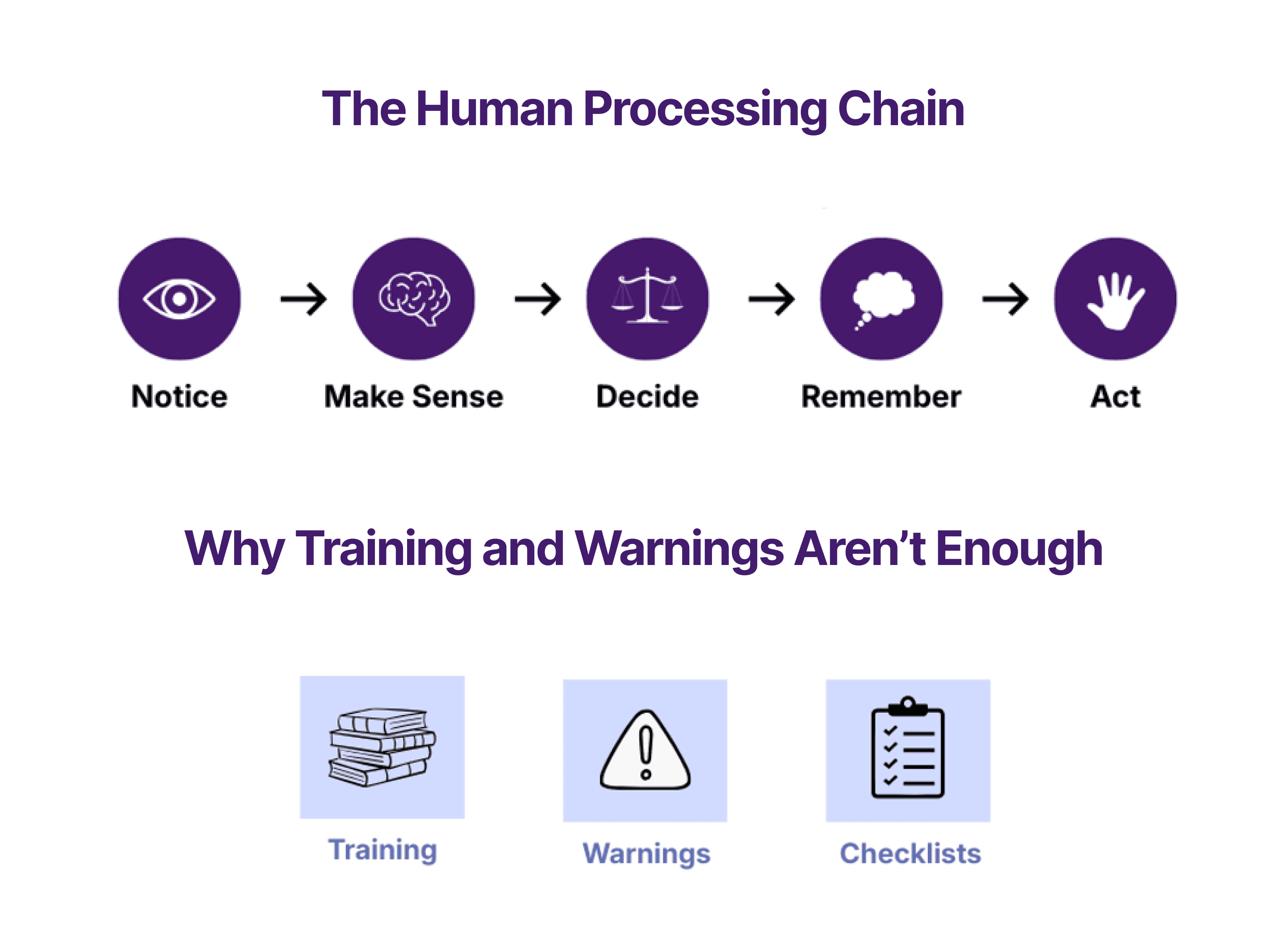
Notice: At the first stage, information must enter awareness. Alerts, indicators, and prompts compete with ambient noise, visual clutter, parallel tasks, and fatigue. During long shifts or high workload conditions, attention narrows. Signals that are present may go unnoticed if they lack salience or prioritization. Zavod noted that many use-related findings trace back to this stage, where detection is unreliable under expected conditions of use.
Make sense: Once information is noticed, users interpret it through existing mental models. Familiarity plays a strong role, especially under time pressure. Devices that resemble others are often assumed to function the same way. Differences in modes, states, or sequences may be overlooked. In usability validation, this appears as foreseeable misunderstanding driven by design similarity.
Decide: Decision-making reflects experience and expectation. Repeated exposure to low-impact alarms conditions users to assign lower urgency. Common workflows are reused without reassessment. Zavod explained how this shapes response timing and appropriateness when device state or patient context changes.
Remember: Task execution depends on working memory, which is sensitive to interruption. Clinical environments involve frequent task switching. Required steps can be dropped without awareness, and tasks may be resumed with missing actions. Regulators frequently encounter this pattern as step omissions or sequence errors that persist despite training controls.
Act: Physical execution introduces additional risk. Similar controls, close spacing, and inconsistent mappings increase the likelihood of incorrect activation. Under stress, motor precision decreases. Many reported use errors occur at this stage even when intent and understanding are aligned. System design determines whether incorrect actions are possible and whether recovery is supported.
Across these stages, Zavod emphasized that the same patterns recur across device classes and user populations. They reflect human behavior under expected use conditions.
Design implications for regulated products
The session also addressed how these behaviors intersect with regulatory expectations. Training, labeling, and warnings support knowledge and awareness. Human performance under real-world conditions remains shaped by attention, memory, and motor limits.
Human factors design focuses on shaping systems that accommodate those limits. Design decisions that reduce opportunities for error, support correct interpretation, guide decision-making, and enable recovery influence usability validation outcomes, post-market performance, and regulatory review.
As Zavod noted, usability issues that repeat across programs often point back to early design assumptions rather than individual user capability.
Watch the session and access usability resources
The full MedTechUX: Conquering the Human webinar is available on demand, along with the presentation slides.
To support teams applying these insights in practice, ClariMed has also made the following resources available:
🎁 21-page Human Factors & Usability Prep Kit
A practical guide designed to help teams prepare for usability activities, support risk management decisions, align documentation with regulatory expectations, and reduce review friction.
👉 Download the prep kit:
📩 Bonus: Prep Kit + 5-day email course
A short, structured email series that breaks usability preparation into one focused step per day.
👉 Access both resources here: